

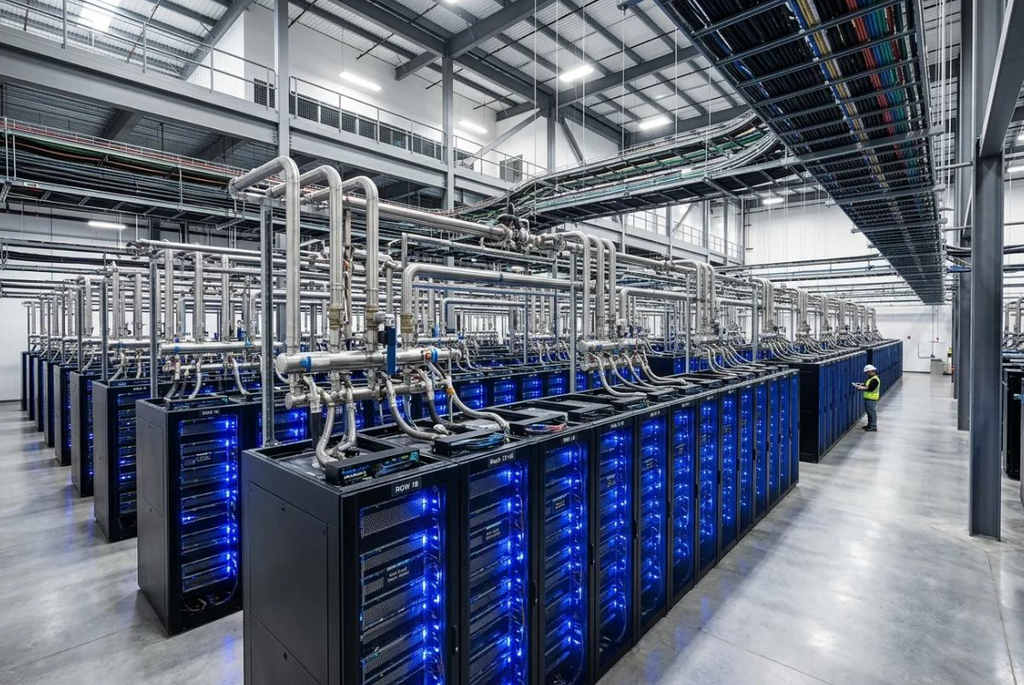
The Race for Power, Chips and Cooling
Artificial intelligence is changing the technology industry, but behind the chatbots, virtual assistants, image generators and automated business tools is a massive infrastructure race that most internet users rarely see.
Some of the world’s largest technology companies are investing hundreds of billions of dollars in computing facilities designed to support the next generation of artificial intelligence. These facilities, known as data centres, contain thousands of powerful computers, networking equipment, storage systems and specialised processors that allow digital services to operate.
However, the latest expansion is different from the data centre growth associated with ordinary websites, email services and cloud storage. Modern artificial intelligence systems can require enormous computing resources, especially when companies train advanced models or operate services that process complex requests at scale.
The result is a global race involving companies that previously competed mainly in software, internet services and computer hardware. Chip manufacturers, cloud providers, construction companies, electricity producers, cooling specialists and telecommunications businesses are increasingly connected to the same expanding market.
A recent example is Samsung’s move into the wider AI infrastructure business. On September 29, 2026, Samsung announced that six of its affiliates would invest a combined US$1 billion in Helix Digital Infrastructure, a company established to develop AI infrastructure, including data centres, electricity systems and fibre-optic networks. A November 15 report by the Financial Times has also highlighted Samsung’s broader ambitions in the data centre market.
The developments raise several important questions. Why does artificial intelligence require so much computing power? Why are companies investing such enormous sums in buildings full of computer equipment? Can electricity networks support this growth? And will the global AI data centre boom make technology more accessible or create new economic and environmental challenges?
Understanding these questions provides a clearer picture of where the technology industry is heading.
What Exactly Is an AI Data Centre?
A data centre is a physical facility designed to house computer systems and the infrastructure required to operate them.
When someone sends an email, saves a photograph online, streams a video, uses a cloud application or accesses an artificial intelligence service, computers located in data centres may be involved in processing and storing the information.
Traditional data centres have supported the internet for decades. Banks, universities, businesses, government departments, technology companies and entertainment platforms all rely on facilities that store information and run digital services.
AI data centres perform many of the same functions, but they are increasingly designed around the specialised computing demands of artificial intelligence.
They contain powerful processors, particularly graphics processing units (GPUs) and other AI accelerators, which can perform large numbers of mathematical operations simultaneously.
These processors help train AI models, process user requests, analyse information and generate results.
A modern AI data centre also needs several other important systems:
- Servers and processors: These perform the calculations required to train and operate AI models
- Storage systems: These hold enormous quantities of information used by software and AI applications
- Networking equipment: This allows thousands of computers to communicate and exchange data
- Cooling systems: These remove heat generated by the computing equipment
- Electrical infrastructure: This delivers reliable power to the facility and its equipment
- Backup systems: These help protect operations during power interruptions and other emergencies
The importance of these supporting systems is increasing as AI workloads become more demanding.
An AI data centre is therefore not simply a large building filled with computers. It is a complex industrial facility that combines computing, engineering, electricity, cooling and telecommunications.
Why Does Artificial Intelligence Require So Much Computing Power?
One of the biggest reasons behind the data centre expansion is the way modern artificial intelligence works.
An AI model is trained using large amounts of information and computing power. During training, specialised processors perform repeated calculations to identify patterns and adjust the model’s internal parameters.
The process can involve enormous datasets and millions or billions of mathematical operations.
Once a model has been trained, it still requires computing resources whenever someone uses it. This process is commonly called inference.
For example, when a person asks an AI assistant to explain a complicated subject, the system processes the request, generates a response and sends the result back to the user.
A simple text question may require relatively modest computing resources compared with training a large model. However, the demand can increase considerably when an AI system generates images, creates videos, reasons through complex problems or performs several tasks using external tools.
The International Energy Agency explains that energy consumption per individual AI task has been improving rapidly due to advances in hardware and software.
At the same time, increasingly sophisticated applications, including video generation, reasoning and agent-based tasks, can require substantially more energy than simple text generation.
This creates an important situation for the technology industry: improvements in efficiency do not necessarily mean total electricity use will fall.
As AI becomes more widely used and its capabilities expand, the overall demand for computing can continue to increase.
The IEA reported that global electricity consumption by data centres grew by 17% in 2025, while electricity consumption by AI-focused data centres increased by approximately 50%.
These figures help explain why technology companies are investing so heavily in additional computing infrastructure.
How Big Is the Global AI Data Centre Investment Boom?
The scale of investment is one of the most remarkable features of the current technology market.
Large cloud providers and technology companies are spending substantial amounts on data centre construction, servers, advanced processors, networking systems and electricity infrastructure.
In its 2026 report Powering Artificial Intelligence, the International Energy Agency estimated that the world’s largest data centre operators, known as hyperscalers, would spend more than US$700 billion in capital expenditure during 2026, with most of that investment directed towards new data centres.
This is a forecast rather than a final accounting of completed expenditure, but it demonstrates how significant the industry’s investment plans have become.
The companies involved include major players in cloud computing, internet services and artificial intelligence.
Their investments are not limited to purchasing computer chips. Building a large data centre also involves acquiring land, constructing facilities, obtaining electricity connections, installing cooling equipment and arranging reliable network connections.
The financial commitments can extend across several years.
This has created opportunities for businesses that supply semiconductors, electrical equipment, cooling systems, construction services, fibre-optic networks and power generation.
The expansion is also attracting financial investors and infrastructure companies that see data centres as an important part of the future digital economy.
The IEA has warned, however, that not every announced project will necessarily be completed. Financing, grid connections, equipment availability, regulation and expectations about future AI demand will influence which projects move forward.
Why Is Samsung Expanding Beyond Chips Into AI Data Centres?
One of the interesting developments in this market is the changing role of traditional technology companies.
Samsung is widely known for smartphones, televisions, memory chips, displays and other electronic products.
Its semiconductor business is particularly important to the global technology industry because advanced computing systems rely on specialised chips and memory components.
However, the expansion of artificial intelligence is creating opportunities beyond the supply of individual components.
On September 29, 2026, Samsung announced that six of its affiliates would invest a combined US$1 billion in Helix Digital Infrastructure.
Samsung Electronics committed US$500 million, while five other Samsung affiliates would provide the remaining US$500 million.
Helix was established by global investment firm KKR in June 2026 to develop and operate infrastructure supporting artificial intelligence.
Its stated activities include hyperscale data centre development, data centre operations, electricity generation, transmission and distribution infrastructure, and fibre-optic networks.
The investment reflects an important change in the AI industry.
Technology companies increasingly recognise that controlling or securing access to the infrastructure behind AI services can be as important as developing the software and computer chips themselves.
Samsung has expertise in semiconductors, batteries, construction, technology services and other industrial sectors.
By participating in a wider infrastructure ecosystem, the company can connect several of these capabilities to the expanding data centre market.
This is not evidence that Samsung will replace established cloud providers. Instead, it illustrates how the AI infrastructure business is attracting companies from different parts of the technology and industrial sectors.
The Financial Times reported on November 15 that Samsung is considering a broader role in data centre development, including infrastructure, cooling and related services.
The development is important because it demonstrates that the AI race is no longer restricted to companies that build AI models.
It also involves businesses that supply the physical systems required to make those models commercially useful.
Why Are Electricity and Cooling Becoming Major Challenges?
An AI data centre can contain thousands of processors operating continuously.
These processors use electricity to perform calculations, and a significant portion of the electricity consumed eventually becomes heat.
Without effective cooling, temperatures can rise to levels that affect performance, reliability and equipment lifespan.
This makes cooling one of the central engineering challenges associated with modern data centres.
Traditional facilities have used air-conditioning systems, fans and other cooling technologies to maintain suitable operating temperatures.
However, advanced AI hardware can generate considerably more heat in a smaller space, placing additional pressure on conventional cooling arrangements.
Some newer facilities are therefore adopting liquid-cooling systems.
Liquid cooling transfers heat away from computing equipment using specialised fluids or water-based systems, depending on the technology.
It can be particularly useful for high-density computing environments where conventional air cooling may struggle to remove heat efficiently.
But cooling is only one part of the electricity challenge.
Data centres also need a reliable power supply capable of supporting their computing equipment around the clock.
In its 2026 analysis, the IEA explained that advanced AI server racks are becoming significantly more power-intensive.
Its projections indicate that by 2027, an individual AI server rack could have peak power demand equivalent to that of approximately 65 households.
This is a measure of peak power demand, not a claim that one rack continuously consumes the same amount of electricity as 65 homes.
The growing power density of AI equipment creates additional engineering requirements for electrical systems, transformers, power electronics and energy storage.
In other words, building a data centre is not simply a matter of finding a large building and filling it with computers.
The electricity supply, cooling arrangements and supporting infrastructure must all be designed to handle the facility’s computing requirements.
How Much Electricity Will AI Data Centres Consume by 2030?
This is one of the most important questions surrounding the global AI expansion.
The International Energy Agency’s 2026 analysis estimates that worldwide data centre electricity consumption could rise from approximately 485 terawatt-hours in 2025 to around 950 terawatt-hours in 2030.
That would represent roughly a doubling of electricity use over five years.
The IEA estimates that data centres could account for approximately 3% of global electricity demand by 2030.
Although this remains a relatively small share of worldwide electricity consumption, the effects can be much more significant in areas where large numbers of data centres are concentrated.
The United States is particularly important in this discussion.
According to the IEA’s earlier analysis of 2024 electricity consumption, the United States accounted for approximately 45% of global data centre electricity use, followed by China at 25% and Europe at 15%.
These figures describe the estimated geographical distribution in 2024 rather than a current 2026 market share.
The IEA’s more recent electricity outlook also identifies data centre expansion as a major driver of projected electricity demand growth in the United States through 2030.
In some regions, power companies and grid planners are facing pressure to provide electricity connections for large facilities while also meeting the needs of households, manufacturing businesses and other industries.
This makes data centre construction an issue that extends beyond the technology sector.
It is increasingly connected to national electricity planning, infrastructure investment and energy policy.
Could the AI Boom Increase Electricity Bills for Ordinary People?
The expansion of data centres has created concerns about the possible effects on electricity prices.
Large data centres require substantial amounts of electricity, and their development can require new power generation, transmission lines, substations and other supporting infrastructure.
When these investments are made, the way their costs are shared becomes important.
In some electricity markets, large industrial users may pay for the infrastructure and power they consume through negotiated arrangements.
However, the wider effects can depend on local regulations, utility pricing structures, grid capacity and whether the costs of new infrastructure are allocated fairly.
The concern is particularly relevant in communities where data centres are concentrated.
If a region requires major electrical upgrades to support new facilities, local residents and smaller businesses may want to understand whether they could face higher electricity costs.
This does not mean that every new data centre automatically increases household electricity bills.
The actual effect depends on how the electricity system is planned, financed and regulated.
The IEA has identified affordability and local grid constraints as important issues that governments and data centre operators must address.
For technology companies, securing reliable power is becoming a central part of decisions about where to build new facilities.
Do AI Data Centres Consume Too Much Water?
Electricity is not the only environmental concern.
Water is also important, particularly for facilities that use water-based cooling systems.
Some data centres use cooling towers and other systems that depend on water to remove heat from computing equipment.
Others rely more heavily on air cooling, liquid cooling arrangements or alternative technologies.
The precise amount of water required depends on factors such as the facility’s size, the computing workload, the local climate, the cooling design and the availability of water resources.
A July 2026 report by the US Congressional Research Service examined the relationship between data centres and water resources.
The report explained that a 100-megawatt US data centre may directly consume approximately the same amount of water per day as 2,600 households, based on an estimate from the IEA.
That is a comparison for a particular facility size and cooling context, not a universal figure for every data centre.
The report also emphasised that water impacts are particularly important in communities where local supplies are already under pressure.
This is why the location of a data centre matters.
A facility operating in a water-abundant region may have a different environmental impact from one located in an area experiencing drought or limited water availability.
Some operators are exploring recycled wastewater, improved cooling designs and more efficient water-management systems.
The challenge is to expand computing capacity without creating avoidable pressure on local water supplies.
Are Technology Companies Turning to Renewable Energy and Nuclear Power?
As data centre electricity demand increases, companies are exploring different ways to secure reliable energy.
Renewable energy is one important part of the response.
Solar and wind power can provide electricity with lower operational carbon emissions than fossil-fuel generation.
However, their output varies according to weather and time of day, so additional infrastructure may be required to ensure that data centres have reliable electricity at all times.
Battery storage can help balance electricity supply and demand by storing energy when it is available and releasing it when required.
Some companies are also exploring nuclear energy as a source of reliable electricity for large computing facilities.
The IEA’s 2026 analysis identifies growing interest in advanced geothermal energy, small modular nuclear reactors, long-duration energy storage and other technologies capable of supporting data centre power needs.
It also reports that technology companies signed 45 terawatt-hours of power purchase agreements during the first half of 2026, nearly 20% more than during the same period in 2025.
Almost 70% of those agreements were in the United States.
Power purchase agreements allow companies to arrange long-term electricity supplies from energy producers, often including renewable energy projects.
These arrangements can support investment in new electricity generation, although the actual effect on the grid depends on how and when the electricity is delivered.
Some US data centre developers have also announced projects involving on-site natural gas generation because connecting to existing electricity networks can take time.
This illustrates a tension in the AI infrastructure market: companies want reliable electricity quickly, but the choice of energy sources has consequences for emissions, costs and energy security.
There is no single solution suitable for every location.
What Does the Data Centre Boom Mean for the Future of Technology?
The expansion of AI infrastructure could influence several areas of the global economy.
First, it may improve the availability and performance of AI services.
More computing capacity can allow technology companies to serve more customers, develop advanced applications and run increasingly complex models.
Second, it could create opportunities across the technology supply chain.
The demand for specialised processors, memory, storage systems, cooling equipment, power electronics, transformers, fibre-optic networks and engineering services may grow alongside data centre construction.
Third, it could encourage innovation in electricity generation and storage.
Technology companies are becoming significant customers for energy infrastructure, creating incentives to develop solutions that can supply large computing facilities more reliably.
Fourth, it could increase competition between countries and businesses seeking to attract data centre investment.
Countries with reliable electricity, strong telecommunications networks, access to capital and supportive regulations may become attractive locations for AI infrastructure.
However, the benefits will not automatically be shared equally.
Regions that lack reliable electricity or adequate network infrastructure may struggle to attract large facilities.
There may also be concerns about employment, water use, environmental impacts and the distribution of economic benefits.
The AI data centre boom is therefore both a technology story and an infrastructure story.
Could the AI Data Centre Boom Become an Investment Bubble?
Another question worth asking is whether the current spending levels can be sustained.
Technology companies are investing enormous sums based on expectations that artificial intelligence will become an increasingly important part of business, government and everyday life.
These expectations have encouraged spending on data centres, processors, networking equipment and electricity infrastructure.
However, the financial returns from these investments are not guaranteed.
A data centre can be expensive to construct and operate. The equipment can require regular upgrades, and the business case depends on attracting sufficient customers and generating enough revenue to cover costs.
If AI adoption grows more slowly than expected, some facilities may struggle to operate at full capacity.
There are also supply-chain risks.
The IEA has identified constraints involving high-bandwidth memory, advanced chips, transformers and other electrical equipment.
If essential components remain difficult to obtain, projects may face delays or higher costs.
Financing is another consideration.
The IEA warns that the scale of data centre investment has grown so large that capital markets will play an increasingly important role in funding expansion.
This makes the pace of construction sensitive to investor confidence, interest rates, expected returns and the broader financial environment.
It is therefore possible that some announced projects will be delayed, redesigned or cancelled.
The long-term outlook for AI infrastructure may remain significant, but that does not mean every individual investment will be profitable.
What Should Businesses and Consumers Expect Next?
For businesses, the expansion of AI infrastructure could bring more advanced cloud services, larger computing capacity and additional artificial intelligence tools.
Organisations may be able to automate more tasks, analyse information more quickly and develop applications that were previously too expensive or difficult to operate.
However, businesses will also need to consider data security, privacy, software costs and dependence on external cloud providers.
Consumers may experience improvements in search, communication, education, entertainment and personal productivity.
AI services could become faster and more capable as infrastructure expands.
But the cost of operating these services may also influence subscription prices, service availability and the range of features offered to users.
For governments, the expansion creates questions about electricity planning, environmental protection, infrastructure investment, competition and digital sovereignty.
Countries may seek to attract data centres while ensuring that local communities and electricity systems are not placed under excessive pressure.
These decisions will help determine how the benefits and costs of the AI infrastructure boom are distributed.
The Bigger Picture: AI Is Becoming an Industrial Infrastructure Business
The global data centre expansion shows that artificial intelligence is no longer only about software developers creating impressive applications.
It is becoming a large infrastructure industry involving semiconductor manufacturing, energy production, construction, cooling technology, telecommunications and financial investment.
The latest moves by companies such as Samsung illustrate how businesses are positioning themselves across this wider ecosystem.
The next stage of AI development will depend not only on how intelligent software becomes, but also on whether the physical systems supporting it can expand efficiently and responsibly.
Reliable electricity, advanced chips, cooling systems, high-speed networks and suitable locations will all influence the future of AI.
The challenge is to build enough computing infrastructure to support useful innovation without creating unnecessary pressure on electricity networks, water resources and local communities.
GPS is one example of technology depending on complex infrastructure. A much larger infrastructure race is now taking place behind artificial intelligence. Explore why tech giants are investing billions in AI data centres.
Final Thoughts
The question of why technology companies are building so many AI data centres has a relatively straightforward starting point: artificial intelligence requires computing resources, and demand for those resources is increasing.
But the consequences are much broader.
The expansion is reshaping investment decisions, creating opportunities for semiconductor and infrastructure businesses, influencing electricity markets and raising new questions about environmental sustainability.
Samsung’s US$1 billion commitment to Helix Digital Infrastructure is one example of how traditional technology companies are moving deeper into the infrastructure supporting artificial intelligence.
The IEA’s projections show that data centre electricity demand could nearly double between 2025 and 2030, although the precise outcome will depend on technology improvements, AI adoption, energy supply and investment conditions.
For ordinary consumers, the changes may eventually appear through faster digital services, more capable AI tools and new products.
For businesses, they could create opportunities to improve productivity and develop new services.
For governments and communities, the challenge will be ensuring that the infrastructure is built in a way that is reliable, financially sustainable and responsible.
The AI revolution may be happening on computer screens, but much of its future will be decided in the physical world: in factories, power stations, server halls, construction sites and the networks connecting them.
Sources and further reading:
- International Energy Agency – Key Questions on Energy and AI (2026):
https://www.iea.org/reports/key-questions-on-energy-and-ai - International Energy Agency – Powering Artificial Intelligence (2026):
https://www.iea.org/reports/powering-artificial-intelligence - International Energy Agency – Electricity 2026:
https://www.iea.org/reports/electricity-2026 - Samsung Global Newsroom – Samsung to Invest USD 1 Billion in AI Infrastructure Company Helix (September 29, 2026):
https://news.samsung.com/global/samsung-to-invest-usd-1-billion-in-ai-infrastructure-company-helix - Financial Times – Samsung Conquered AI Chips. Now It Wants to Build Data Centres (November 15, 2026):
https://www.ft.com/content/ee5b23b3-89b3-41f7-9158-56c1586759c2 - US Congressional Research Service – Data Centers and Water: Frequently Asked Questions (July 31, 2026):
https://www.everycrsreport.com/reports/R49057.html - US Energy Information Administration – EIA Expects Record Electricity Generation in 2026 and 2027 (September 9, 2026):
https://www.eia.gov/pressroom/releases/press592.php

Leave a Reply