

What Caused the November 2026 Air Traffic Outage?
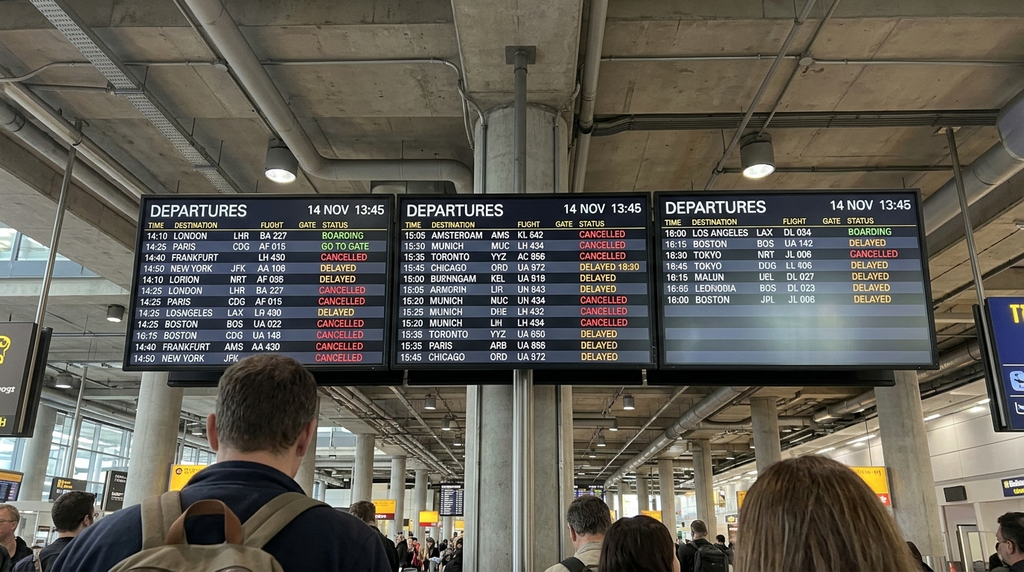
Thousands of travellers across the United States faced cancelled flights, lengthy delays and disrupted travel plans after the Federal Aviation Administration (FAA) ordered an unprecedented nationwide ground stop on Friday, November 13, 2026.
The decision followed communication and radar-data problems affecting multiple air traffic control facilities. For more than four hours, departing flights across the country were ordered to remain on the ground while aviation officials worked to understand the problem and restore confidence in the systems used to manage aircraft movements.
Although the ground stop was eventually lifted, its consequences continued into the weekend. Airlines had to reorganise schedules, reposition aircraft and crews, accommodate stranded passengers and work through a backlog of disrupted flights.
The incident also raised a much larger question: how could a problem involving telecommunications equipment being upgraded at a remote location affect air traffic operations across an entire country?
The explanation provided by US transportation officials points towards a combination of ageing infrastructure, an equipment problem during routine maintenance and the interconnected nature of modern air traffic control.
Investigators are examining whether an incorrectly installed router, a faulty piece of equipment or an error during installation caused the disruption. Officials have said that the investigation has not yet established the final cause.
The event has renewed attention on the condition of America’s air traffic control infrastructure, which has been undergoing a major modernisation programme.
What happened on November 13 was therefore more than an ordinary airport delay. It exposed the importance of reliable communications systems, careful infrastructure upgrades and the technology that allows thousands of aircraft to move safely through American airspace every day.
What Happened When the FAA Ordered a Nationwide Ground Stop?
The disruption began on Friday afternoon, November 13, 2026.
According to US Transportation Secretary Sean Duffy, instability affecting radar and communications systems was detected at approximately 3:36 p.m. Eastern Time.
The problems affected air traffic control facilities responsible for communicating with aircraft and coordinating movements across different parts of the national airspace.
The FAA initially announced that it had issued a nationwide ground stop for all US airports following communication issues affecting multiple Air Route Traffic Control Centers.
The decision was made as a safety precaution.
Rather than allowing normal departures to continue while the reliability of the affected systems was uncertain, aviation authorities ordered departing traffic to remain grounded.
It is important to understand what this meant. A nationwide ground stop did not mean that every aircraft suddenly stopped flying in mid-air. More than 3,500 aircraft were already airborne when the situation developed.
Air traffic controllers and pilots used established safety procedures to manage those aircraft and bring them safely to landing.
Duffy said that the number of aircraft remaining in the air eventually fell below 400 as aircraft continued landing.
The restrictions affected departures at airports across the United States, while inbound international flights were managed on a case-by-case basis.
The US Department of Transportation later confirmed that the airspace reopened at 8:15 p.m. Eastern Time on Friday.
That meant the nationwide restriction lasted for more than four hours, although the wider disruption to airline operations continued long after departures were allowed to resume.
The FAA and transportation officials thanked air traffic controllers, pilots, flight attendants, airport personnel and ground crews for helping manage the situation.
Their response was particularly important because the priority was to maintain safe aircraft separation and communication while the affected systems were being assessed.
Why Did the FAA Ground Flights Across the Entire Country?
This is perhaps the most important question surrounding the incident.
A problem at a single technical location might appear to be something that engineers could repair locally without affecting airports across an entire country.
However, the US air traffic control system relies on communications infrastructure that connects multiple facilities.
Air traffic control is not performed independently by each airport. Different facilities cooperate to manage aircraft movements from departure through the various stages of a flight until landing.
At an airport, the control tower manages aircraft movements on runways and nearby areas.
A Terminal Radar Approach Control facility, commonly known as a TRACON, manages aircraft arriving at and departing from major airport areas.
Beyond these facilities are the Air Route Traffic Control Centers, which manage aircraft travelling through larger sections of airspace, particularly during the cruising portion of a journey.
These facilities depend on reliable communications and radar information to maintain awareness of aircraft positions and coordinate instructions.
The November outage affected several parts of this network.
Reuters reported that the communication problem affected 17 of the FAA’s 22 en-route centres.
Although officials said that no centre completely lost all communications or went dark, the instability was serious enough to interfere with the reliable exchange of data.
FAA Administrator Bryan Bedford said the agency ordered the nationwide ground stop because officials could not rule out the possibility that a centre might lose communications completely.
The decision was therefore made to protect aviation safety rather than risk allowing normal departures to continue under uncertain conditions.
Aviation authorities must be able to rely on accurate information when aircraft are operating close to one another.
When that information becomes unstable, even temporarily, the appropriate response may be to reduce traffic until the problem can be understood.
What Actually Caused the Air Traffic Control Communication Failure?
The preliminary explanation provided by US officials points towards a router problem during routine telecommunications maintenance.
The work involved replacing older copper-based telecommunications connections with modern fibre-optic infrastructure.
The contractor responsible for the work was L3Harris, a company that has provided telecommunications infrastructure services to the FAA for more than two decades.
The purpose of the upgrade was to move parts of the system away from older technology towards fibre-based communications.
However, according to Duffy’s account, a router involved in the conversion began sending an unusually large number of connection attempts to other routers within the air traffic control network.
Officials said the system experienced more than 1,000 connection attempts every four to five seconds.
This placed an unexpected load on other parts of the communications infrastructure and contributed to inconsistencies in the data used by air traffic control facilities.
Those inconsistencies affected communications with aircraft and caused disruption to radar feeds.
The problem was not described as a complete telecommunications blackout. Instead, the concern was that the information being exchanged had become unstable and could not be relied upon with the level of confidence required for normal operations.
Duffy said the government was investigating whether the problem resulted from:
- An error by someone carrying out the installation.
- An error during the configuration or use of the equipment.
- A faulty router or another defective component.
The US government had not established which of these possibilities was responsible when the latest detailed briefing was given on November 14.
L3Harris said it was supporting the FAA’s investigation and took the disruption and its effects on passengers and airlines seriously.
Reuters also reported that officials were examining equipment installed at remote locations in Arkansas and Texas.
It is important to avoid presenting the router as a confirmed final cause. It was the leading explanation given by officials, but the investigation was continuing.
The distinction matters because identifying a component involved in an incident is not the same as proving exactly why it failed.
Why Did a Routine Maintenance Project Create Such a Serious Problem?
The incident raises a difficult question about the relationship between old infrastructure and modern technology.
Replacing old telecommunications connections with fibre-optic systems is generally part of infrastructure modernisation.
Fibre can support high-speed data transmission and is widely used by modern telecommunications networks.
The FAA has been working to move away from older copper-based connections because parts of its communications infrastructure were built decades ago.
According to the Government Accountability Office (GAO), some of the copper communications infrastructure being replaced dates back to the 1960s.
However, upgrading a large operational network is not simply a matter of removing old equipment and connecting new hardware.
Different components must work together, and the replacement process must be carefully tested to ensure that new equipment does not introduce problems into systems that are still operating.
The FAA’s telecommunications network supports essential air traffic control functions.
If an upgrade creates instability in the wider network, the effects can extend beyond the individual location where the work was performed.
This is why maintenance arrangements, equipment testing, configuration checks and contingency procedures are particularly important in aviation infrastructure.
Duffy said the work was routine and involved switching a telecommunications connection from older copper technology to fibre.
He also said the government would review the timing and procedures used for similar maintenance projects.
One issue under consideration was whether certain equipment changes should be performed at different times, particularly where a technical problem could have wider consequences.
The intention behind replacing old equipment is to improve reliability. However, the transition itself must be managed carefully because the old and new systems may need to operate together while the upgrade is being completed.
The November incident demonstrates why modernisation programmes must consider not only the advantages of new equipment but also the risks associated with installing it in a system that cannot simply be switched off.
How Many Flights Were Cancelled or Delayed?
The effects of the ground stop extended well beyond the hours during which departures were restricted.
When an aircraft cannot operate as scheduled, the consequences can affect several other flights.
Airlines rely on carefully organised schedules involving aircraft, pilots, flight attendants, airport gates and connecting passengers.
An aircraft scheduled to operate several flights in one day may become unavailable for later journeys if an earlier departure is cancelled or delayed.
Crew members may also reach the limits of their permitted working hours, requiring airlines to find replacement staff.
According to FlightAware figures reported by Reuters, the scale of disruption was substantial.
As of 9:35 p.m. Eastern Time on Saturday, November 14, the reported figures were:
| Date | Cancelled flights | Delayed flights |
|---|---|---|
| Friday, November 13 | Approximately 9,200 | Approximately 7,500 |
| Saturday, November 14 | More than 6,400 | More than 8,000 |
At that same reporting point, FlightAware said 875 flights scheduled for Sunday had already been cancelled.
These were time-specific figures rather than final totals. They were also flight-operation counts, not a count of individual passengers.
Reuters separately reported that the disruption had affected more than 20,000 flights since Friday.
The numbers demonstrate why reopening the airspace did not immediately restore normal travel.
Airlines had to work through cancelled services, late departures, displaced aircraft and crews, missed connections and passengers waiting for alternative arrangements.
The situation also affected flights involving international routes.
Although the ground stop applied to US airports, international passengers travelling into or out of the United States could be affected through delayed departures, interrupted connections and aircraft operating out of position.
Why Did the Problems Continue After the Ground Stop Was Lifted?
A common misunderstanding is that once aviation authorities remove a ground stop, the entire airline system immediately returns to normal.
That is rarely how a large disruption works.
The FAA can reopen the airspace and allow flights to depart, but airlines still need the operational resources required to operate their schedules.
For example, an airline may have an aircraft scheduled to leave New York for Los Angeles, but the aircraft could still be sitting at another airport because its earlier journey was disrupted.
The airline may also have a crew that has reached its permitted duty limit and cannot legally operate the next flight without replacement personnel.
Passengers may have missed connecting services, while airport gates and ground-handling resources may be occupied by delayed aircraft.
These problems create a chain reaction.
A cancelled flight can affect the aircraft’s next assignment. That can affect a different route, which may then affect passengers travelling to another destination.
The same process can occur with pilots, cabin crew, baggage operations and airport staff.
In addition, airlines cannot always restore every cancelled flight simply by adding extra departures. They must consider aircraft availability, airport capacity, crew scheduling and safety regulations.
The US Transportation Department said more than 8,000 flight operations resumed on Friday night after the ground stop was lifted.
Nevertheless, officials warned passengers to expect further cancellations and delays while the airlines restored their schedules.
On Saturday, FAA Administrator Bryan Bedford said he expected airline operations to largely return to normal by late Sunday.
Was the November 2026 Outage Caused by a Cyberattack?
Concerns about cyberattacks emerged because the incident involved communications networks that support critical national infrastructure.
A disruption affecting several air traffic control facilities naturally raises questions about whether someone deliberately interfered with the system.
However, US officials said they had found no evidence pointing to a cyberattack.
Homeland Security Secretary Markwayne Mullin said officials had seen no evidence of malicious activity or a rogue artificial intelligence system.
Duffy also said the government did not believe the problem was caused by a cyberattack.
The preliminary explanation focused instead on equipment and telecommunications instability during a maintenance operation.
However, it is still important to distinguish between an initial assessment and the final findings of an investigation.
Investigators were continuing to examine the circumstances surrounding the incident.
Readers should therefore be cautious about social media claims suggesting that hackers had taken control of American air traffic systems.
The available official information did not establish such a claim.
The same caution applies to speculation that artificial intelligence caused the outage.
US officials specifically said they had found no evidence of an AI-related failure.
The government also explained that the incident was separate from the FAA’s SMART airspace-management tool, which provides information and recommendations to human controllers rather than independently controlling aircraft.
Is This the First Time the United States Has Experienced a Nationwide Flight Ground Stop?
No, but nationwide ground stops are unusual.
One major comparison is the January 11, 2023 outage involving the FAA’s Notice to Air Missions system, commonly known as NOTAM.
NOTAM information provides pilots and other aviation personnel with important notifications about conditions that could affect flight safety.
These notifications may cover runway closures, equipment failures, airspace restrictions, navigation problems and other operational information.
In January 2023, the FAA temporarily halted domestic departures after the NOTAM system stopped functioning properly.
A preliminary investigation found that contract personnel had unintentionally deleted files while working to correct synchronisation problems between a live database and a backup database.
The incident disrupted more than 11,000 flights.
Although both the 2023 and 2026 incidents involved old or vulnerable technology within the US aviation system, they were not the same failure.
The 2023 incident involved the database supporting NOTAM information.
The November 2026 incident involved telecommunications and radar-data instability affecting air traffic control centres.
That distinction is important.
It would be misleading to suggest that the same technical problem occurred twice.
Nevertheless, both incidents demonstrate the consequences that failures in critical aviation technology can have on national travel operations.
The November 2026 incident was described by Reuters as the longest nationwide aviation shutdown since the September 11, 2001 attacks.
The comparison demonstrates how unusual the scale of the disruption was.
How Old Is America’s Air Traffic Control Infrastructure?
The ground stop has renewed scrutiny of the technology supporting the US National Airspace System.
According to the Government Accountability Office, the FAA operates numerous systems that support air traffic control, communications, surveillance, weather monitoring and aircraft management.
These systems must work together to allow controllers to manage aircraft safely and efficiently.
However, maintaining older infrastructure has become increasingly difficult.
In its September 2026 report, GAO explained that the FAA had previously assessed 138 air traffic control systems.
Of those systems:
- 51 were classified as unsustainable.
- 54 were classified as potentially unsustainable.
Together, that represented more than three-quarters of the systems assessed.
GAO identified issues such as outdated functionality, limited availability of replacement parts, reduced technical expertise in older technologies and increasing demands on the airspace.
The organisation also found that the FAA had experienced difficulties completing modernisation projects on schedule.
This background helps explain why the November telecommunications failure attracted so much attention.
The problem was not simply that one router had malfunctioned.
It occurred within a much larger system that government auditors had already identified as needing significant modernisation.
What Is the FAA Doing to Modernise the System?
The FAA has been implementing a major programme known as the Brand New Air Traffic Control System, or BNATCS.
The programme is intended to accelerate the replacement and improvement of outdated systems.
The first phase focuses on modernising areas including communications, surveillance, weather systems and controller training.
In July 2025, Congress appropriated US$12.5 billion to support the programme.
According to GAO, the FAA plans to complete the first phase by December 2028.
As of May 2026, the agency reported replacing 2,560 of 5,170 older copper communications wires with high-speed fibre-optic cables.
The second phase is intended to introduce new automation systems to improve aircraft tracking and traffic management.
However, GAO has raised concerns about the way the modernisation programme is being managed.
Its September 2026 report found that the FAA had not prepared a comprehensive, well-documented lifecycle cost estimate or an integrated master schedule for the first phase.
Instead, it had 11,389 individual project schedules that were not fully integrated.
GAO warned that weaknesses in cost and schedule planning could create risks of delays, cost overruns and performance problems.
This means that modernising America’s air traffic infrastructure is not only a question of funding.
It also requires careful project management, technical coordination, testing and oversight.
What Does the Incident Mean for International Travellers?
The November ground stop was a US national aviation event, but its effects were not limited to American domestic passengers.
The United States is a major international aviation market.
Many international airlines operate services to and from American airports, while other airlines depend on US airports for passenger connections and onward journeys.
When departures are restricted across the US, international passengers can experience disruptions even if their flights originate outside the country.
A person travelling from another continent may be scheduled to connect through New York, Chicago, Atlanta, Los Angeles or another American airport.
If a connecting aircraft or crew is delayed, the passenger’s onward journey may also be affected.
International flights arriving in the United States were managed on a case-by-case basis during the ground stop.
Airlines also had to consider how to reposition aircraft and crews once normal departures resumed.
The incident therefore highlights the international importance of the US aviation system.
A disruption in one country’s airspace can affect passengers, airline schedules and connections across several continents.
For travellers, the practical lesson is to monitor airline notifications, check flight status before leaving for the airport and contact the airline when a departure or connection changes.
What Happens Next in the Investigation?
The FAA and L3Harris are continuing to examine the technical circumstances behind the outage.
The key questions include whether the router involved in the telecommunications upgrade was faulty, incorrectly installed or improperly configured.
Officials also need to determine why the equipment generated such a large volume of connection attempts and how the wider network responded.
The investigation should help identify whether similar equipment or configurations exist elsewhere in the system.
Reuters reported that the FAA was carrying out additional testing with L3Harris to assess whether other risks remained.
L3Harris said it was supporting the investigation and noted that more than 70% of the planned conversion from legacy copper connections to fibre-optic communications had been completed.
Transportation officials have also said they will review how and when certain maintenance work is performed.
The wider modernisation programme is likely to remain a central issue in discussions about the reliability of the US aviation system.
Any future infrastructure improvements will need to balance the urgency of replacing outdated equipment with the requirement to maintain safe operations while the work is being completed.
Has US Air Travel Returned to Normal?
The nationwide ground stop has been lifted, and flights have resumed.
On Sunday, November 15, the FAA’s Air Traffic Control System Command Center published a national airspace status report that showed no active national ground-stop or delay programme at 11:09 GMT.
However, that status snapshot should not be interpreted as confirmation that every airline or airport had completely returned to its normal schedule.
Airlines were still working through the operational consequences of the preceding two days, and individual cancellations or delays could continue.
Passengers should check directly with their airline for the latest information about their particular flight.
Final Thoughts: Why the November 2026 FAA Ground Stop Matters
The nationwide ground stop of November 13, 2026, showed how essential reliable communication systems are to modern aviation.
What initially appeared to be a technical maintenance problem developed into a nationwide disruption because the affected infrastructure supported communications and radar information used by multiple air traffic control facilities.
The FAA’s decision to restrict departures was made as a safety precaution while the instability was investigated.
Thousands of aircraft were already in the air when the incident began, and officials said controllers and pilots safely brought them to landing.
Although the ground stop was lifted later that evening, the disruption continued as airlines worked to restore aircraft, crews and passenger schedules.
The preliminary explanation points towards a router-related problem during work to replace older copper telecommunications connections with fibre.
However, investigators had not established the final cause as of the latest detailed government briefing on November 14.
The incident has also renewed attention on the wider challenge of replacing ageing air traffic control systems.
For travellers, the immediate priority is to check flight information and follow airline instructions.
For aviation authorities, the task is much larger: ensure that the infrastructure supporting the world’s busiest national airspace remains reliable while essential upgrades are carried out.
The November ground stop is a reminder that modern aviation depends on more than aircraft, pilots and airport runways. It also depends on the communications networks, radar systems, computers and technical infrastructure that allow the entire system to function safely.
Sources and further reading:
- Federal Aviation Administration – Statement on Nationwide Ground Stop, November 13, 2026:
https://www.faa.gov/newsroom/faa-statement-nationwide-ground-stop - US Department of Transportation – Announcement on Lifting of Nationwide Ground Stop, November 13, 2026:
https://www.transportation.gov/briefing-room/icymi-us-transportation-secretary-sean-p-duffy-announces-lifting-nationwide-ground - US Department of Transportation – Update on Restoration of Airspace, November 14, 2026:
https://www.transportation.gov/briefing-room/icymi-us-transportation-secretary-sean-p-duffy-provides-update-restoration-airspace - Reuters – US to Resume Flights After Air Traffic Network Failure Sparks Chaos, November 13, 2026:
https://www.reuters.com/world/us/faa-issues-national-ground-stop-due-extraordinary-circumstance-reasons-safety-2026-11-13/ - Reuters – US Aviation Shutdown Blamed on L3Harris-Installed Router, November 14, 2026:
https://www.reuters.com/business/aerospace-defense/us-aviation-shutdown-blamed-l3-harris-installed-router-2026-11-14/ - Reuters – US Air Travel Disruptions to Persist Until Late on Sunday, FAA Head Says, November 14, 2026:
https://www.reuters.com/business/aerospace-defense/thousands-us-flights-canceled-delayed-air-travel-system-recovers-shutdown-2026-11-14/ - US Government Accountability Office – Air Traffic Control Systems: Ambitious New Modernization Effort Needs to Improve Cost and Schedule Planning, September 14, 2026:
https://files.gao.gov/reports/GAO-26-107992/index.html - Federal Aviation Administration – FAA NOTAM Statement, January 19, 2023:
https://www.faa.gov/newsroom/faa-notam-statement - FAA Air Traffic Control System Command Center – National Airspace Status:
https://www.fly.faa.gov/ois/oisedit/summary_pub

Leave a Reply