

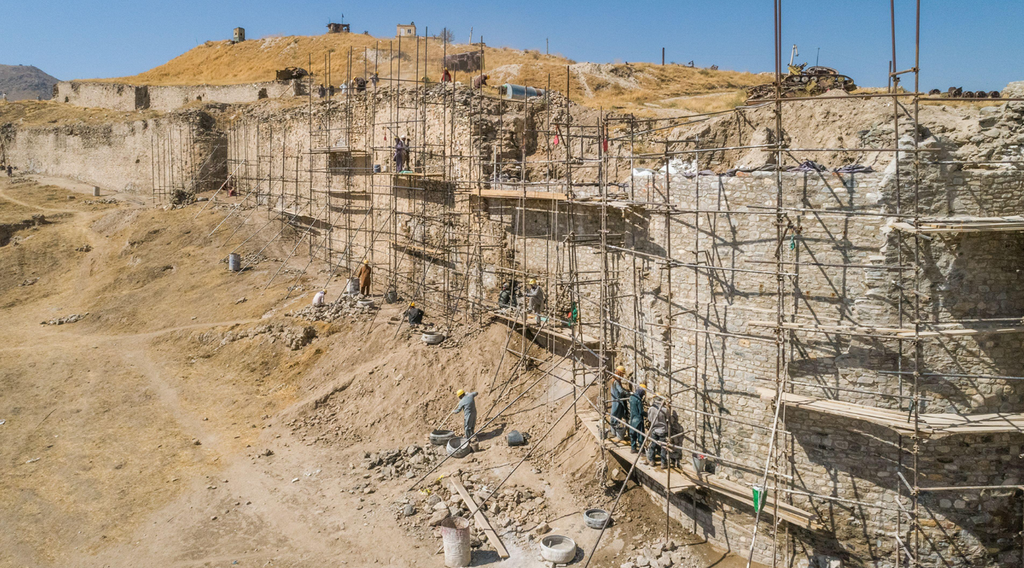
Ancient Bala Hissar Fortress Is Revealing More Than 2,000 Years of Afghan History
High above the old city of Kabul, Afghanistan, stands the remains of an ancient fortress that has witnessed centuries of invasions, political struggles, religious change and the rise and fall of powerful rulers.
Known as Bala Hissar, meaning “High Fort” in Dari, this historic complex is now attracting renewed attention as archaeologists uncover remarkable evidence of the people and civilisations that once occupied it.
Recent excavations have revealed ancient coins, fragments of Buddhist sculptures, Islamic ceramics, oil lamps, pottery and remains of long-lost buildings. Among the most surprising discoveries are the remains of a Mughal palace decorated with murals and a distinctive star-shaped pool carved into the rock.
The discoveries are part of a major conservation project led by the Aga Khan Trust for Culture. Its goal is not only to protect the surviving fortress but also to transform the historic site into a public archaeological park.
For Afghanistan, a country whose history has repeatedly been shaped by war and political upheaval, the work offers an opportunity to preserve a remarkable part of its cultural heritage.
What Is Bala Hissar, and Why Was It Important?
Bala Hissar is situated on a rocky ridge overlooking the southern part of Kabul’s historic city. Its elevated position gave it a commanding view of the surrounding landscape and made it strategically important for anyone seeking to defend or control the city.
The name Bala Hissar translates to “High Fort”, an appropriate description for a fortress built above the surrounding settlements.
However, the site was much more than a military structure. Over different periods, it served as a fortress, royal palace, administrative centre, arsenal, prison and military garrison.
Its location was also significant because Kabul stood along important routes connecting the Indian subcontinent with Central Asia and other parts of the region. Controlling the city therefore meant having influence over important commercial and strategic routes.
Archaeological observations conducted by the French Archaeological Delegation in Afghanistan confirmed that major defensive structures existed on the ridge by at least the second century BC.
This suggests that the area had been strategically occupied long before many of the later rulers and dynasties associated with Kabul came to prominence.
Archaeologists Are Uncovering More Than Two Millennia of History
The recent discoveries have made Bala Hissar particularly interesting to historians and archaeologists.
According to the Associated Press, excavations across five separate trenches have uncovered a variety of objects and architectural remains.
These include ancient coins, fragments of Buddhist statues, glazed Islamic ceramics, oil lamps and numerous pieces of pottery.
Researchers have also identified evidence of former homes, monasteries and palace buildings.
The discoveries are particularly valuable because they reveal that Bala Hissar was not simply a military outpost. It was part of a wider human settlement where different communities lived, worshipped, traded and governed.
One of the most remarkable discoveries is the remains of a Mughal palace.
Archaeologists have identified remnants of decorated walls, murals, a structure resembling a throne and a star-shaped pool carved into the rock near the highest part of the hill.
The palace remains provide evidence of the wealth and architectural ambitions associated with the Mughal period.
One archaeological trench has already reached approximately 11 metres below the surface, and researchers believe there is still more to investigate.
Archaeologist Babak Rafiei-Alavi described the discoveries as far more extensive than expected, comparing the process to a submarine emerging from the ocean.
The comparison captures the excitement of discovering structures and objects that have remained hidden beneath accumulated layers of earth for centuries.
The Buddhist and Islamic History Hidden Within the Fortress
One of the most interesting aspects of Bala Hissar is the evidence of different religious and cultural traditions found within the same historic landscape.
Fragments of Buddhist statues and traces of a Buddhist monastery demonstrate the importance of Buddhist communities in the region’s earlier history.
Afghanistan was once an important centre of Buddhist culture, particularly during periods when trade routes connected South Asia, Central Asia and territories farther west.
The wider Kabul region contained Buddhist religious sites, monasteries and monuments. Nearby archaeological locations such as Tepe Naranj and Tepe Maranjan provide further evidence of this history.
As political and religious influences changed over the centuries, Islamic architecture, artistic traditions and everyday objects also became part of the region’s cultural landscape.
The glazed ceramics, oil lamps and other Islamic-era materials uncovered at Bala Hissar help researchers understand these later periods.
Rather than representing one single civilisation, the archaeological remains tell a story of cultural exchange and transformation.
They demonstrate how different communities contributed to the history of Kabul over many generations.
The Fortress Has Survived Centuries of War and Destruction
Bala Hissar’s history is not only a story of rulers, architecture and archaeological discoveries. It is also a story of conflict.
Its strategic position made it an important military location, meaning it repeatedly became involved in struggles for control of Kabul.
One of the most destructive episodes occurred during the Second Anglo-Afghan War.
On September 3, 1879, the British diplomatic mission led by Sir Louis Cavagnari was attacked at Bala Hissar and its members were killed. The incident helped trigger the British military campaign that followed.
British troops subsequently destroyed much of the fortress as an act of retaliation.
The damage was so extensive that only parts of the original palace and fortification complex survived.
The remains of Bala Hissar also endured further periods of conflict, including the Soviet invasion, civil war and later military operations.
According to archaeologists interviewed by the Associated Press, even some modern military activities damaged archaeological layers that could have contained valuable historical evidence.
Today, remnants of older military equipment can still be found within the wider fortress complex.
These remains add another chapter to a site that has repeatedly been used as a symbol of political and military power.
A Major Restoration Project Is Giving Bala Hissar a New Future
Recognising the historical importance of the fortress, the Aga Khan Trust for Culture began planning a major conservation project in 2017. Initial work focused on documenting the site and stabilising structures that were at risk of collapsing.
The project also involved technical surveys, ground-penetrating radar and three-dimensional laser scanning to understand the condition of the surviving buildings and fortifications.
Conservation work began in 2018, with support from the ALIPH Foundation and cooperation from heritage specialists.
Following the Taliban’s return to power in 2021, the French archaeological delegation halted its work. However, the Aga Khan Trust for Culture continued its activities, carrying out more extensive work from 2022 onward.
Restoration teams have been rebuilding sections of the defensive walls using locally sourced stone.
An important principle of the conservation work is that new construction should remain distinguishable from the original historic material. This helps future researchers identify what is ancient and what has been restored.
Metal reinforcements have also been used to stabilise an exterior tower that had split and was at risk of collapse.
The project is ambitious. Its long-term vision is to create a public archaeological park with landscaped gardens, a museum and facilities for visitors.
It also includes training opportunities for Afghan archaeology students, helping develop local expertise in the protection and study of historic sites.
In April 2026, Afghanistan’s Ministry of Information and Culture reported that officials had visited the site’s laboratory, antiquities exhibition, museum and restoration areas. The ministry said discovered objects were being examined in the on-site laboratory, preserved in the local museum and subsequently transferred to the National Museum.
These activities demonstrate that the project involves both the preservation of buildings and the careful study and management of archaeological discoveries.
Why Preserving Bala Hissar Matters for Afghanistan
Afghanistan has an exceptionally rich history, but decades of conflict, political instability, neglect and destruction have placed many historic monuments at risk.
The destruction of the giant Buddha statues at Bamiyan in 2001 remains one of the most widely recognised examples of cultural heritage loss in the country.
The damage to museums and historic sites during different periods of conflict has also demonstrated how easily valuable historical evidence can disappear.
Bala Hissar therefore represents an important opportunity to protect what remains and make more of Afghanistan’s history accessible to future generations.
The work also raises an important issue about cultural preservation: archaeological sites are valuable not only because of the objects they contain but also because they help communities understand their identity and relationship with the past.
The current Afghan authorities have publicly expressed support for preserving historic monuments. The country’s previous Taliban government was responsible for destroying the Bamiyan Buddhas and damaging museum collections, making the present conservation effort particularly significant in historical context.
Whether the planned archaeological park eventually develops into a major public attraction will depend on sustained conservation, research, funding and the ability to make the site safely accessible.
A Fortress That Still Has Stories to Tell
Bala Hissar has survived centuries of political change, destruction and reconstruction. Yet archaeologists are still discovering evidence of the communities that once lived and worked within its walls.
The Buddhist remains, Islamic artefacts, Mughal palace structures and military fortifications show that its history is far more complex than that of an ordinary fortress.
The latest discoveries are also a reminder that history is not always found in books or museums. Sometimes it lies hidden beneath the ground, waiting for careful archaeological work to bring it back into view.
As conservation continues in Kabul, Bala Hissar may yet reveal more details about Afghanistan’s past.
For a country whose history has so often been associated with conflict, preserving this ancient fortress offers something equally important: an opportunity to protect and share the stories of the civilisations that helped shape it.

Leave a Reply