

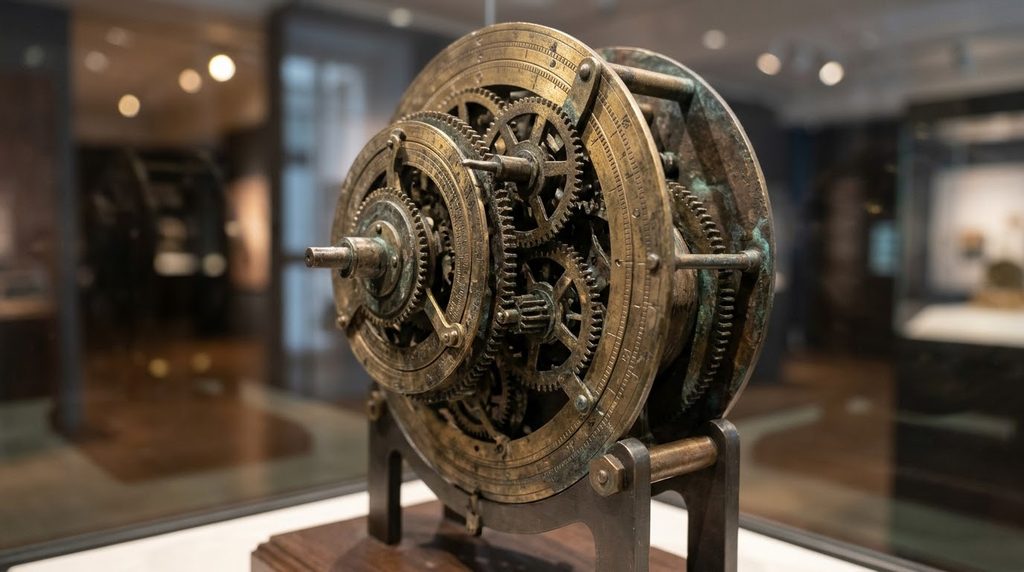
More than 2,000 years ago, Greek craftsmen created a machine so sophisticated that no known device of comparable complexity appeared for roughly another millennium. It contained an intricate arrangement of bronze gears, carefully designed scales and inscriptions that helped its users understand the movements of the heavens.
Today, this extraordinary object is known as the Antikythera Mechanism. It is often described as the world’s oldest known analogue computer because it used mechanical calculations to represent astronomical cycles and calendar information.
The machine was not discovered in a palace, library or ancient workshop. It was recovered from a shipwreck beneath the Mediterranean Sea, where it had remained for centuries. Its discovery transformed historians’ understanding of ancient Greek science and engineering.
Interest in the mechanism has gained fresh attention in 2026. A functional reconstruction is being exhibited in Rome, allowing visitors to see how researchers believe this remarkable machine worked. The exhibition, hosted at Villa Mellini, opened on November 7, 2026, and is scheduled to run until April 21, 2027.
But how did an ancient civilisation build something so advanced? What could the mechanism calculate? And why did such a sophisticated invention disappear from the historical record?
What Was the Antikythera Mechanism?
The Antikythera Mechanism was an ancient Greek geared device designed to model astronomical movements and related calendar cycles. It was made primarily from bronze and contained a complex system of interlocking gears.
Its surviving fragments show that the machine was much more than an ordinary timekeeping instrument. It represented the relationship between different astronomical cycles and helped users follow the movements of celestial bodies.
Researchers have identified displays and calculations associated with the Sun, Moon, lunar phases, eclipses and calendar systems. The mechanism also included information connected with the timing of major athletic festivals in the ancient Greek world.
This is why it is commonly described as an ancient analogue computer. It did not operate with electricity, software or digital information. Instead, it used physical gears and carefully arranged mechanical relationships to represent mathematical and astronomical patterns.
The surviving object is incomplete. It consists of corroded fragments rather than a fully preserved machine. As a result, researchers have had to combine inscriptions, X-ray images, mathematical analysis and mechanical reconstruction to understand its original design.
The mechanism is now preserved at the National Archaeological Museum in Athens, Greece.
Where Was the Ancient Computer Discovered?
The story of the Antikythera Mechanism began in the waters near the Greek island of Antikythera, located between Crete and the Peloponnese.
Around 1900, a group of Greek sponge divers discovered an ancient shipwreck while working underwater. The wreck contained an extraordinary collection of objects, including marble and bronze sculptures, pottery, glassware and other valuable cargo.
The divers were working in difficult underwater conditions. The wreck lay at considerable depth, making the recovery operation challenging for the equipment available at the time.
Among the recovered objects was a heavily corroded lump of bronze. At first, it did not look like an important scientific instrument. Its appearance was damaged by centuries underwater, and its internal structure was hidden beneath layers of corrosion.
The object was eventually recognised as something unusual after it had been taken to the National Archaeological Museum in Athens. As the corrosion changed and pieces became more visible, researchers noticed what appeared to be small gear wheels.
The discovery was remarkable because ancient mechanical devices of this complexity were not expected to have existed during that period.
The shipwreck itself is generally dated to the first century BC, although researchers continue to investigate the site’s history, cargo and formation. The mechanism is commonly dated to somewhere around the second or first century BC.
How Did Scientists Realise It Was a Computer?
For years, the damaged bronze fragments presented a difficult puzzle. The visible gears suggested a mechanical device, but understanding its purpose required more than simply examining its exterior.
One of the most important developments came from the use of advanced imaging technologies.
In the twentieth century, researchers began studying the object more systematically. The work of historian of science Derek de Solla Price was particularly influential. His investigations helped establish the idea that the mechanism was an ancient astronomical calculating device.
Later research made it possible to examine details hidden inside the corroded fragments. X-ray imaging and other advanced techniques revealed gear structures and inscriptions that could not be properly understood from the surface.
The Antikythera Mechanism Research Project, which began in the early 2000s, used technologies including micro-focus X-ray computed tomography and imaging methods that helped researchers examine the inscriptions and internal construction.
These investigations changed the discussion from speculation about a mysterious bronze object to a much more detailed understanding of its mechanical design.
Researchers could study the number of gear teeth, the arrangement of the wheels and the writing engraved on the surviving surfaces. Each discovery helped explain how the different parts may have worked together.
However, the mechanism remains incomplete, and not every detail of its original construction or operation is settled.
What Could the Antikythera Mechanism Calculate?
The machine’s most remarkable feature was its ability to represent astronomical cycles through mechanical movement.
1. The movements of the Sun and Moon
The mechanism included displays associated with the positions of the Sun and Moon. These helped users follow their movements through the sky according to the astronomical understanding of the ancient Greek world.
The Moon does not move across the sky at the same apparent rate as the Sun. Its changing position and appearance create cycles that ancient astronomers studied carefully.
The mechanism used gears to represent these relationships. A user could operate the device by turning a handle, causing the internal components and indicators to move.
2. The phases of the Moon
The Moon changes appearance throughout its monthly cycle, moving through new moon, crescent, first quarter, full moon and other phases.
The Antikythera Mechanism included a display associated with lunar phases. This was an important feature because lunar observations were connected to calendars, religious festivals and the organisation of time.
The mechanism’s designers understood that astronomical cycles could be represented mechanically, allowing a user to follow patterns without having to calculate everything from the beginning.
3. Solar and lunar eclipses
One of the most impressive functions associated with the device was its ability to represent eclipse cycles.
Solar and lunar eclipses do not happen every month because the Sun, Earth and Moon must align under particular conditions. Ancient astronomers studied recurring patterns to understand when eclipses were more likely to occur.
The mechanism included a spiral display associated with the Saros cycle, a period of approximately 18 years, 11 days and 8 hours after which similar eclipse conditions repeat.
This did not mean the device could predict every detail with the precision of modern astronomy. It represented recurring astronomical patterns understood in its historical context.
Nevertheless, the ability to model eclipse cycles through gears was an extraordinary engineering achievement.
4. Calendars and the timing of festivals
The mechanism also contained calendar-related displays.
One important cycle was the Metonic cycle, which connects 235 lunar months with approximately 19 solar years. This relationship was useful for coordinating lunar months with the solar year.
Another display was associated with the timing of major Panhellenic athletic festivals. These events brought people from different Greek communities together and formed an important part of ancient Greek cultural life.
The device therefore connected astronomy with everyday organisation, religious observance and public events.
5. The movements of planets
Researchers have also investigated the mechanism’s representation of the known planets. The ancient Greek understanding of the heavens included the visible movements of Mercury, Venus, Mars, Jupiter and Saturn.
Exactly how all planetary displays were arranged in the original machine remains a subject of research and reconstruction. Some components are missing, and scholars continue to debate aspects of the device’s original design.
The important point is that the mechanism belonged to a sophisticated tradition of ancient mathematical astronomy.
Who Built the Antikythera Mechanism?
One of the biggest unanswered questions is the identity of the person or workshop responsible for creating the device.
No surviving inscription clearly identifies its inventor. Researchers have proposed possible connections with important centres of ancient Greek astronomy and engineering, including Rhodes.
Rhodes was an important centre of learning and scientific activity in the Hellenistic period. It was associated with influential thinkers and astronomers, including Hipparchus, whose work contributed significantly to the development of ancient astronomy.
However, a possible connection with a particular location or intellectual tradition does not establish who personally built the machine.
It is also possible that the mechanism was the product of a workshop involving several skilled craftsmen rather than a single inventor.
Creating such a device required knowledge of mathematics, astronomy, metalworking and precision engineering. Its maker or makers would have needed to understand how gear ratios could represent complicated astronomical relationships.
The absence of a confirmed inventor is part of what makes the mechanism so fascinating.
How Advanced Was Ancient Greek Engineering?
The Antikythera Mechanism challenges the assumption that complex mechanical engineering began only in the modern period.
Ancient Greek thinkers made significant contributions to mathematics, astronomy, geometry and mechanical design. The mechanism provides physical evidence that at least some ancient workshops could translate advanced mathematical knowledge into intricate machinery.
Its gears were not decorative objects. Their sizes and tooth arrangements were related to specific cycles and calculations.
The machine also demonstrates the relationship between scientific knowledge and practical craftsmanship. Astronomical theories alone would not have been enough. Someone had to turn those ideas into a functioning mechanical instrument.
This required skilled workers who could cut, assemble and align small metal components with considerable care.
It is important, however, not to exaggerate what the discovery proves. The Antikythera Mechanism does not show that ancient Greeks possessed modern computers, electronics or industrial manufacturing systems. It demonstrates that ancient engineers developed an exceptionally sophisticated mechanical calculating device within the technological possibilities of their time.
Why Did the Technology Disappear?
If the Antikythera Mechanism was so advanced, why did similar machines not become common throughout the ancient world?
There is no single confirmed answer.
One possibility is that the device represented a specialised tradition rather than a technology produced in large numbers. Its manufacture would have required rare expertise, expensive materials and considerable time.
Another possibility is that other examples were built but have not survived. Bronze objects were frequently melted down and reused in later periods. Mechanical devices could also have been damaged, dismantled or lost.
Ancient technological knowledge was not always preserved in a continuous written or manufacturing tradition. A skill could become less common if the workshops, teachers or institutions supporting it disappeared.
The surviving historical record is also incomplete. The fact that only one famous example has survived does not prove that no other similar machines existed.
The mechanism therefore raises a broader question about the history of technology: how many important inventions disappeared because their physical evidence was lost?
What Has Modern Technology Revealed About the Mechanism?
Modern research has transformed the study of the Antikythera Mechanism.
When the object was first recovered, researchers could examine only the damaged exterior and the visible fragments. Today, imaging technologies allow scientists to investigate internal structures without dismantling the surviving pieces.
X-ray computed tomography has helped reveal gear arrangements and inscriptions hidden within the corrosion. Digital modelling allows researchers to test how different components might have interacted.
Mechanical reconstruction is another important approach. By building working models based on the surviving evidence, researchers can examine whether proposed gear arrangements are physically possible.
The FRAME project, which stands for Functional Reconstruction of the Antikythera Mechanism, has worked on reconstructing the device’s bronze components and testing how they could operate together.
The Max Planck Institute for the History of Science has also listed a 2025–2026 research project focused on the mechanism’s inscriptions. These writings are important because they help explain the information displayed by the machine and provide clues about its wider historical context.
Modern technology has not removed every mystery. Instead, it has made it possible to ask more precise questions.
Why Is the Antikythera Mechanism Back in the News in 2026?
The mechanism has remained a subject of scientific and public interest for decades, but 2026 has brought a fresh opportunity for wider audiences to encounter it.
On November 7, 2026, a functional reconstruction of the Antikythera Mechanism opened to visitors at Villa Mellini, the headquarters of Italy’s National Institute for Astrophysics in Rome.
The exhibition, titled Ingranaggi Celesti: Il meccanismo di Antikythera e la sua eredità, presents the reconstructed machine alongside other instruments and objects connected with the history of astronomical mechanics.
The exhibition is scheduled to continue until April 21, 2027. It explores the mechanism’s origins, how it may have worked, recent interpretations and its influence on later traditions of astronomical instruments.
The reconstruction is especially valuable because the original object is incomplete. A working model allows visitors to see how gears and indicators can translate astronomical cycles into physical movement.
It also demonstrates how historians, scientists and engineers can work together to investigate an ancient invention.
The exhibition does not mean that every historical question has been answered. Rather, it gives the public an opportunity to understand the current state of research and the continuing effort to reconstruct the machine.
What Does the Antikythera Mechanism Teach Us About Ancient History?
The Antikythera Mechanism is important because it provides evidence of a sophisticated relationship between science, mathematics and engineering in the ancient world.
It shows that ancient Greek astronomers did not merely observe the sky. They developed mathematical systems to describe recurring patterns and created mechanical tools that could represent those patterns.
It also reminds historians that technological progress is not always a simple straight line. Knowledge can develop in remarkable ways, become concentrated among a small number of specialists and later become difficult to reproduce.
The mechanism is also a reminder that archaeological discoveries can change established historical assumptions. A damaged object recovered from a shipwreck has forced researchers to reconsider what ancient engineers could achieve.
Its story connects several fields: underwater archaeology, ancient trade, astronomy, mathematics, metalworking, the history of science and the preservation of cultural heritage.
For that reason, it deserves attention beyond the label of an ancient computer.
Could the Antikythera Mechanism Be the World’s First Computer?
Calling the Antikythera Mechanism the world’s first computer is a useful way to communicate its importance, but the phrase needs some explanation.
It was not a modern electronic computer. It did not store digital files, run software or process information in the way today’s machines do.
It is more accurately described as an ancient analogue computer. Its gears represented mathematical relationships and astronomical cycles through physical movement.
The word computer itself has changed meaning over time. Historically, it could refer to a person or device that performed calculations. Today, it usually brings to mind electronic machines.
The Antikythera Mechanism belongs to a much older history of calculating devices. Its significance is not that it was identical to a modern computer, but that it demonstrates how far mechanical calculation had developed in the ancient world.
Another Remarkable Discovery from Ancient History
The Antikythera Mechanism is not the only ancient discovery that continues to change how we understand the past. Another extraordinary example is the famous Library of Alexandria, whose history raises important questions about ancient knowledge, scholarship and the preservation of human civilisation. Read our detailed article: What Happened to the Great Library of Alexandria?.
Conclusion: An Ancient Machine That Still Challenges Our Understanding of History
The Antikythera Mechanism is one of the most extraordinary discoveries in the history of archaeology and science.
Recovered from a shipwreck near a small Greek island, the corroded bronze fragments revealed a machine designed to represent astronomical cycles, lunar phases, eclipses and calendar information.
Its construction demonstrates that ancient Greek engineers possessed an impressive understanding of mathematics, astronomy and mechanical design.
More than a century after its discovery, researchers are still studying its inscriptions, reconstructing its components and examining unanswered questions about its original purpose and manufacture.
The renewed public attention surrounding the 2026 Rome exhibition shows that the mechanism remains relevant to discussions about science, technology and European history.
Perhaps its greatest lesson is that the history of computing did not begin with electricity. Long before modern computers existed, people were already building machines to turn mathematical knowledge into practical tools.
The Antikythera Mechanism is a surviving reminder of just how inventive the ancient world could be.
Sources & References
These are useful references to retain for fact-checking and credibility:
- Italy’s National Institute for Astrophysics — Rome exhibition and reconstruction. The 2026 exhibition, its dates and the reconstruction.
- Max Planck Institute for the History of Science — The Inscriptions of the Antikythera Mechanism. Research on the inscriptions and historical interpretation.
- 2026 archaeological study of the Antikythera shipwreck. Research into the shipwreck’s archaeological context.
- Euronews — The Antikythera mechanism: ancient Greek computer that predicted eclipses. Accessible background on the machine and its functions.

Leave a Reply